

The best way to tell if amber is real is to look at several characteristics together — including its weight, appearance, natural variation and response to light — rather than relying on a single home test.
Natural amber is fossilized tree resin. It is lightweight, can vary greatly in color and transparency, and often shows subtle differences from one piece to another. However, modern plastics and synthetic resins can imitate amber surprisingly well, so visual inspection alone cannot guarantee authenticity.
For greater certainty, professional gemological testing is more reliable than any simple home test.
What Does Real Amber Look Like?
Real amber can appear in many different colors and levels of transparency.
Natural amber may be pale yellow, golden, orange, reddish-brown or darker brown. It can also be transparent, cloudy or completely opaque. Jewelry sellers commonly use descriptive trade names such as honey, cognac, lemon and cherry for different amber appearances.
These names describe the way the amber looks, but color alone cannot prove authenticity or tell you whether a piece has been treated.
Genuine amber can also contain natural patterns, cloudy areas, small inclusions and differences in transparency.
The Gemological Institute of America (GIA) describes amber as an organic material rather than a mineral, with a specific gravity of about 1.08 — one reason it feels unusually lightweight for its size.
Look for Natural Variation
Natural amber often shows subtle differences from one piece to another.
- slight changes in color between beads;
- cloudy or clearer areas;
- small internal patterns;
- changes in transparency;
- occasional natural inclusions.
These characteristics can support the impression that the material is natural.
However, they are not proof on their own. Modern imitation materials can also be deliberately manufactured with irregularities to resemble genuine amber.

Is Real Amber Lightweight?
Yes. Genuine amber is particularly lightweight compared with materials such as glass and many mineral gemstones.
A large-looking amber piece can therefore feel surprisingly light when held.
This can sometimes help identify obvious glass imitations. GIA has documented artificial-glass amber imitations that are substantially denser than natural amber.
But lightweight plastic and synthetic resin can also resemble amber, so weight should never be used as the only authenticity test.
How to Tell If an Amber Necklace Is Real
If you are checking a real amber necklace, look at several clues together rather than relying on one test. Genuine amber necklaces are usually lightweight, may show natural variation between beads, and can include differences in color, transparency and internal texture.
An authentic amber necklace does not need to look perfectly uniform. In fact, small variations between beads can be normal in natural material. However, irregularity alone is not proof of authenticity because imitation materials can also be manufactured to look natural.
Also check the product description and seller information. A trustworthy seller should clearly state whether the necklace is made from genuine Baltic amber, where the amber comes from, and whether the material is natural, treated or reconstructed.
How to Tell If an Amber Teething Necklace Is Real
The same principles apply to an amber teething necklace. If you want to know whether an amber teething necklace is real, check the weight, bead variation, seller information and material description together.
A genuine amber teething necklace may contain beads that differ slightly in shade, translucency or texture. These natural differences can be a useful sign, but no single visual feature can confirm authenticity.
Home tests such as salt water, static electricity or UV light can provide supporting information, but they should not be treated as definitive proof. For greater certainty, professional gemological testing is much more reliable.
Natural Amber, Treated Amber and Imitations
Not every amber-looking product fits neatly into only two categories: “real” or “fake.”
Amber products on the market can include untreated natural amber, treated amber, reconstructed or pressed amber, composites, and imitation materials.
Natural Amber
Natural amber is fossilized tree resin that has formed naturally over millions of years.
It may later be cut and polished for use in jewelry.

Treated Amber
Natural amber can be treated to change its color, clarity or appearance.
Treatment does not automatically mean that the underlying material is fake amber, but it does mean the appearance may not be completely natural.
Reconstructed or Pressed Amber
Smaller pieces of amber can be processed and pressed together to create a larger piece.
Laboratory techniques such as FTIR spectroscopy can help distinguish natural, reconstructed and imitation amber materials.
Amber Imitations
Common imitation materials include:
- Plastic — can imitate natural amber colors and may also be lightweight.
- Synthetic resin — can closely reproduce amber's transparency, color and appearance.
- Glass — can resemble transparent amber visually but is generally much heavier.
- Copal — natural tree resin that is geologically younger than amber and can sometimes be difficult to distinguish visually.
Can You Test Amber in Salt Water?
The salt-water test is one of the most commonly recommended amber tests online.
Because amber has a relatively low density, some amber can float in sufficiently concentrated salt water while heavier materials sink.
But the test has serious limitations.
Finished jewelry may contain string, clasps and other components that affect the result. Some imitation materials can also float.
Gem-A has demonstrated examples in which both amber and plastic beads floated in concentrated salt water, showing why the test should not be treated as definitive proof.
For finished amber jewelry, we would not recommend relying on a salt-water test to determine authenticity.
Does Real Amber Create Static Electricity?
Amber is well known for its ability to develop a static electrical charge when rubbed against certain materials.
After rubbing amber against wool or another suitable fabric, it may attract very lightweight objects.
This property is interesting, but it is not a reliable standalone authenticity test.
Plastic can behave in a similar way. Gem-A's comparison also showed that both amber and plastic samples could become electrically charged, so static electricity should be treated as supporting information rather than proof.
Does Real Amber Glow Under UV Light?
Amber can fluoresce when exposed to ultraviolet light.
Depending on the piece, the response may appear bluish, greenish or vary in intensity.
UV examination can therefore provide useful supporting information.
However, it should not be treated as absolute proof that a piece is genuine because fluorescence can vary between natural amber specimens and some imitation materials may also react to UV light.
For this reason, UV inspection works best as one piece of evidence among several.
Tests You Should Avoid
Some online guides recommend testing amber with fire, a heated needle or chemical solvents.
We do not recommend destructive tests on finished amber jewelry.
- They can permanently mark the amber.
- They can damage its polished surface.
- They may affect its color or finish.
- They can damage thread, clasps or other components.
If authenticity really matters, professional identification is preferable to deliberately damaging the jewelry.
Is Color a Sign That Amber Is Real?
Color alone cannot determine whether amber is genuine.
Natural amber occurs in a wide range of appearances, and treatments can also alter amber's color or clarity.
For that reason, a particularly attractive honey, cognac or dark-colored piece should not be considered genuine solely because of its color.
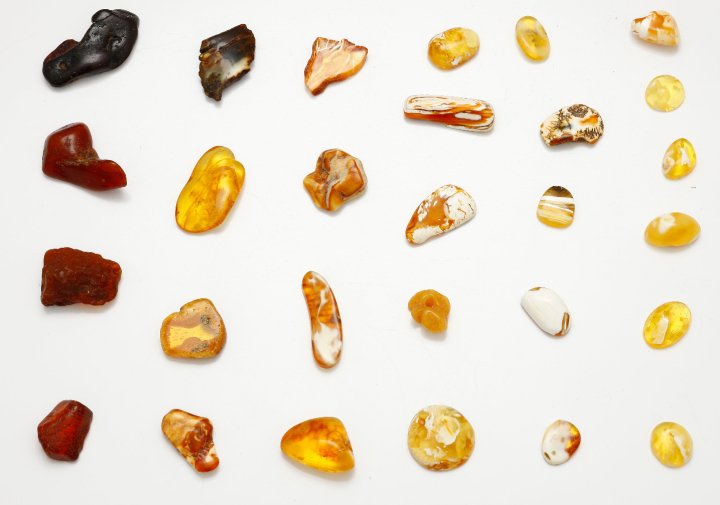
Raw vs Polished Amber
Both raw and polished amber can be genuine natural amber.
Raw amber generally retains more surface texture and often has a matte, more organic appearance.
Polished amber has been smoothed and polished, creating a shinier finish and often making its color and transparency more visible.
Polishing changes the surface appearance of amber — it does not by itself determine whether amber is genuine.
How Is Baltic Amber Professionally Identified?
When greater certainty is required, gemologists can use laboratory techniques rather than relying on visual inspection or simple home tests.
One important technique is Fourier-transform infrared spectroscopy (FTIR).
Amber from the Baltic region shows a characteristic infrared absorption pattern generally between approximately 1160 and 1250 cm⁻¹, commonly known as the “Baltic shoulder.” This feature can help gemologists distinguish Baltic-region amber from amber originating elsewhere.
FTIR analysis can also help identify some plastic imitations and reconstructed amber materials. For more technical detail, see GIA's research on infrared spectroscopy and natural, reconstructed and imitation amber.
For ordinary jewelry purchases, laboratory testing is usually unnecessary, but it demonstrates why professional identification is much more reliable than a single home test.
Where Does Genuine Baltic Amber Come From?
Baltic amber is associated with the Baltic Sea region, where amber has been collected and worked for centuries.
Lithuania has a particularly strong tradition of amber craftsmanship and jewelry making.
At Baltic Amber Stones, our jewelry is handcrafted in Lithuania using genuine natural Baltic amber.
Learn more about Baltic amber.
How Can You Be More Confident You Are Buying Real Amber?
For most buyers, the most practical approach is not trying to prove authenticity with one trick at home.
Instead, look at the complete product and the seller.
A trustworthy amber seller should clearly explain:
- what material the jewelry is made from;
- where the amber originates;
- whether natural Baltic amber is being used;
- where or how the jewelry is produced;
- what the actual product looks like.
Be cautious of sellers who rely only on dramatic home-test claims such as “if it floats, it must be real.”
Authenticity is better evaluated using several characteristics together — and professional testing when certainty is required.
Genuine Baltic Amber Jewelry
At Baltic Amber Stones, we use genuine natural Baltic amber in jewelry handcrafted in Lithuania.
Natural differences in color, transparency and texture mean individual pieces of amber can vary slightly from one another.
These variations are part of the natural character of amber.
If you're researching amber jewelry for children, you can also read our guide: What Is an Amber Teething Necklace?
Explore Baltic Amber Teething Necklaces
Frequently Asked Questions
How can you tell if amber is real?
Look at several characteristics together rather than relying on one test. Genuine amber is lightweight and may show natural variation in color, transparency and texture. Professional gemological testing provides much stronger evidence than simple home tests.
Does real amber float?
Amber can float in sufficiently concentrated salt water because of its low density. However, some imitation materials can also float, so this does not prove that amber is genuine.
Is real amber always transparent?
No. Natural amber can range from transparent to cloudy or completely opaque.
Does real amber glow under UV light?
Amber can fluoresce under ultraviolet light, although the color and strength of fluorescence vary. UV response can provide useful information but is not definitive proof of authenticity.
Can fake amber look real?
Yes. Modern plastics, synthetic resins and other imitation materials can closely resemble natural amber in color, transparency and texture.
Can real amber be treated?
Yes. Natural amber can be treated to modify its color, clarity or appearance. Treated natural amber and imitation amber are not the same thing.
Is Baltic amber real amber?
Yes. Baltic amber is natural fossilized tree resin associated with the Baltic Sea region. Laboratory FTIR analysis can reveal a characteristic spectral pattern commonly called the “Baltic shoulder.”
Further Reading
For deeper gemological information about amber, see the Gemological Institute of America amber guide and Gem-A's published research on amber identification.


